
Cousin Chart
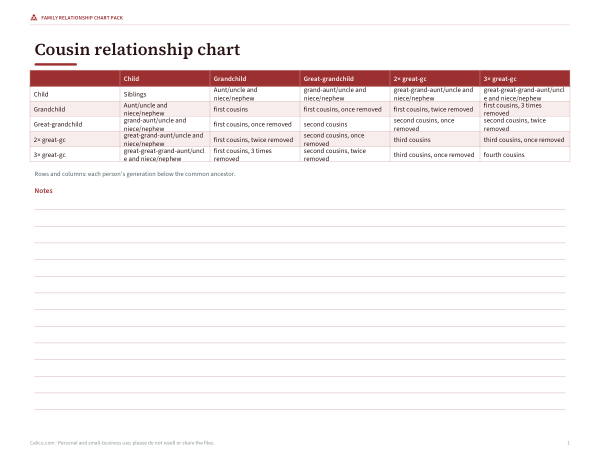
Confused by “second cousin once removed”? Pick how many generations each person is below your shared ancestor, and the cousin calculator names the relationship, explains it in plain words and shows the average share of DNA relatives like this have in common. A full cousin chart is below for printing.
- Free to use
- No sign-up
- Runs in your browser

Cousin relationship calculator
Family Relationship Chart Pack
Printable cousin relationship chart, a blank five-generation family tree, a descendant chart, a DNA match tracker and a family reunion name tag sheet.
- Cousin chart (PDF)
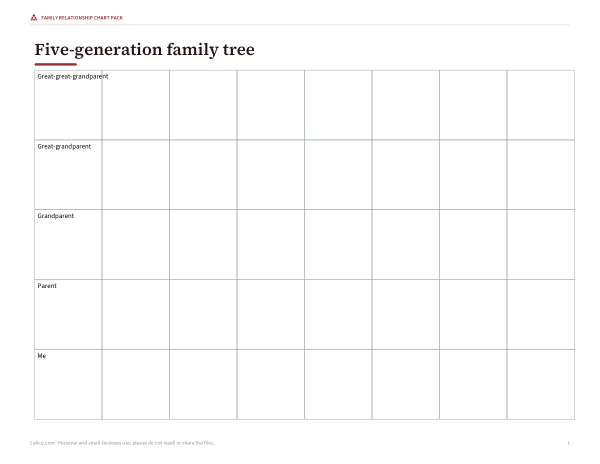
- Five-generation tree (PDF, DOCX)
- DNA match tracker (XLSX)
- Reunion name tags (PDF, DOCX)
Formats: PDF, DOCX, XLSX. Instant download after payment (link valid 72 hours, up to 5 downloads). AI-assisted: the templates were drafted with AI help and reviewed and laid out before publishing.
$5.00 USD, one-time 4 files · about $1.25 each
- Instant download
- 7-day refund
- Secure checkout by Stripe
7-day money-back guarantee. Full refund within 7 days of purchase, even after you download.
Free sample: Cousin Relationship Chart (PDF, 58 KB)
Full refund within 7 days — see the refund policy and license.
Free printables
Single sheets you can print right now, no sign-up. The full pack adds every sheet in one download plus the editable files.
 Printable Reunion Name Tags
How cousin relationships work
Cousins share a common ancestor but neither descends from the other. Two numbers describe every cousin relationship. The degree — first, second, third — tells you how far back the shared ancestor is: first cousins share grandparents, second cousins share great-grandparents, third cousins share great-great-grandparents. The removal — once, twice — tells you how many generations apart the two people are. Your first cousin’s child is your first cousin once removed, because they are one generation below you.
The simple rule
- Find the most recent ancestor you both descend from.
- Count generations from that ancestor down to each person: a child is 1, a grandchild 2, a great-grandchild 3.
- Take the smaller number and subtract 1 — that is the cousin degree (2 → first cousins, 3 → second cousins).
- The difference between the two numbers is the number of times removed.
Example: you are the ancestor’s grandchild (2) and your relative is a great-grandchild (3). The smaller number is 2, so you are first cousins; the difference is 1, so once removed.
Cousin chart
| Child | Grandchild | Great-grandchild | 2× great-grandchild | |
|---|---|---|---|---|
| Child | Siblings | Aunt/uncle – niece/nephew | Grand-aunt/uncle – grand-niece/nephew | Great-grand-aunt/uncle |
| Grandchild | Niece/nephew | First cousins | First cousins once removed | First cousins twice removed |
| Great-grandchild | Grand-niece/nephew | First cousins once removed | Second cousins | Second cousins once removed |
| 2× great-grandchild | Great-grand-niece/nephew | First cousins twice removed | Second cousins once removed | Third cousins |
Read across from one person’s row and down from the other’s column to find the relationship. “Grand-aunt” and “great-aunt” are both used for a parent’s aunt.
“Removed” is not about age
People often assume a much older cousin must be “removed”, but removal is about generations, not years. In large families, a first cousin can be twenty years older than you and still be your first cousin, because you are both grandchildren of the same grandparents. Conversely, a first cousin once removed may be the same age as you — for example, your parent’s much younger first cousin.
Half and double cousins
- Half cousins share only one ancestor rather than a couple — for example, children of half-siblings are half first cousins. They share, on average, half as much DNA as full cousins of the same degree.
- Double cousins are related through both sides of the family — for example, when two brothers marry two sisters, their children are double first cousins and share about as much DNA as half-siblings.
- Step-cousins are related by marriage only and share no ancestry.
Shared DNA between cousins
| Relationship | Average shared DNA | Typical range |
|---|---|---|
| First cousins | 12.5% | Roughly 4–23% |
| First cousins once removed | 6.25% | Roughly 2–13% |
| Second cousins | 3.125% | Roughly 0.4–8% |
| Third cousins | 0.78% | Can be 0% |
| Fourth cousins | 0.2% | Often no detectable match |
Averages follow halving each generation; the ranges reflect published data from genetic genealogy projects and vary between sources. Because DNA is inherited in random chunks, some third and more distant cousins share no detectable DNA at all.
Worked example
Maya’s grandmother and Leo’s great-grandmother were the same woman. Maya is a grandchild (2) and Leo a great-grandchild (3) of that ancestor. The smaller number, 2, minus 1 gives first cousins; the difference, 1, gives once removed. Maya and Leo are first cousins once removed, and on average share about 6.25% of their DNA. Leo’s children would be Maya’s first cousins twice removed, and Maya’s children would be Leo’s second cousins.
Relationships through marriage
Cousin terms describe blood relatives. The spouse of your first cousin is usually just called “my cousin’s husband” or “cousin-in-law”; there is no formal degree. Your spouse’s cousins are your cousins-in-law. Step-relationships follow the same pattern: your step-parent’s nephew is your step-cousin. In family trees, record the relationship to the person through whom the link exists, and the chart above applies only to shared ancestry.
What about aunts, uncles and nieces?
When one person is the child of the common ancestor, the relationship is not a cousin one. Your parent’s sibling is your aunt or uncle, and you are their niece or nephew. Your grandparent’s sibling is your great-aunt or great-uncle (also called grand-aunt or grand-uncle), and you are their grand-niece or grand-nephew. The calculator shows these as “aunt/uncle and niece/nephew” lines.
Using the chart in family history
When building a family tree, write each person’s generation number below the shared ancestor on the chart, then read off the relationship. It helps to label cousins correctly in family tree software, write clear captions on old photographs, and understand DNA match predictions from testing services, which usually give a range of possible relationships based on the amount of shared DNA.
Privacy
The calculator runs in your browser and stores nothing.
Frequently asked questions
What is a second cousin?
Someone who shares great-grandparents with you — your parent’s first cousin’s child.
What does once removed mean?
You are one generation apart; for example, your first cousin’s child is your first cousin once removed.
What is my parent’s cousin to me?
Your first cousin once removed.
What are my cousin’s children to my children?
Second cousins.
How much DNA do first cousins share?
About 12.5% on average.
Is my data stored?
No, nothing is stored.
Are cousins once removed the same generation?
No. “Removed” means they are one generation apart, whatever their ages.